
The Human Culture Effect in Practice
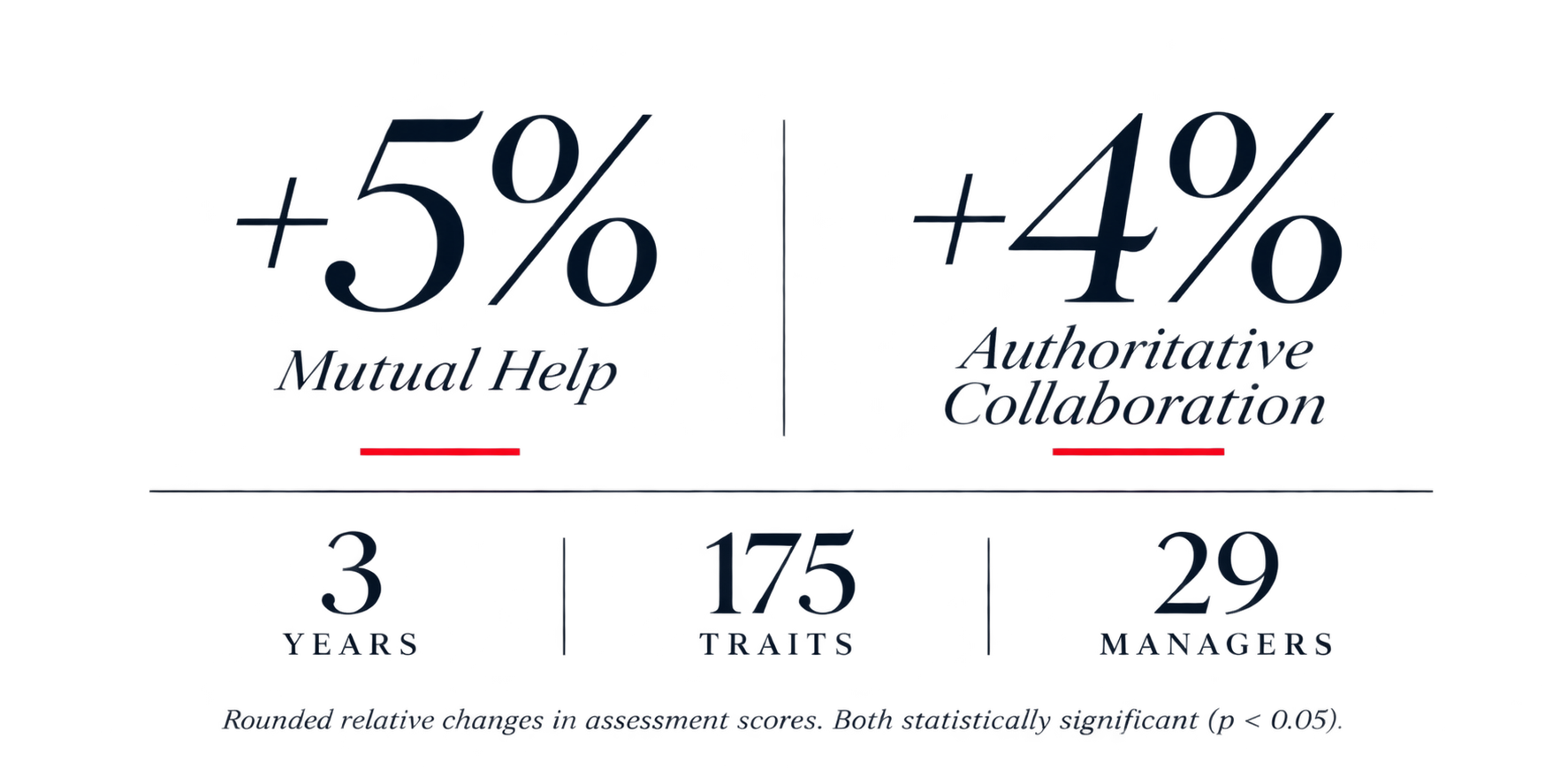
Three years of cultural development. 175 traits measured. Statistically significant results.
Can investing in organisational culture create measurable changes in how people lead and work together?
Over a three-year period, a large Swedish industrial organisation of several thousand employees worked actively with our Human Culture training programmes and methodology to strengthen its leadership and organisational culture. To evaluate the development, 29 of its managers completed assessments at the beginning and end of the three-year period, measuring 175 different traits across a broad range of personal and professional characteristics. Importantly, participants were not informed which specific traits were of particular interest, helping to reduce the risk of expectation-driven responses.
The Results
Among the statistically significant changes, two characteristics were particularly noteworthy:
Helpful and Authoritative.
These were not simply positive developments. They were directly aligned with the behaviours Human Culture Group's programmes are designed to strengthen. The improvements were also reflected in two broader leadership dimensions:
+5% Mutual Help: An improvement in the ability to support and help others while maintaining the confidence to assert one's own needs.
+4% Authoritative Collaboration: An improvement in taking responsibility for decisions while remaining open to collaboration and others' perspectives.
Both dimensions demonstrated statistically significant improvements (p < 0.05).
Why These Findings Matter
What makes these results particularly compelling is the connection between the organisation's three-year investment in Human Culture development and the specific behaviours that changed.
The assessment examined 175 different traits, many unrelated to the programme's core objectives. Yet among the statistically significant improvements were Helpful and Authoritative — two characteristics closely aligned with the principles at the heart of Human Culture Group's methodology.
This alignment is particularly meaningful. Rather than simply reporting general improvements in leadership, the findings demonstrate measurable development in behaviours the programmes specifically aim to strengthen.
While the assessment cannot establish causation on its own, it provides encouraging evidence of the potential impact of sustained, intentional cultural development.
The Human Culture Effect: turning cultural development into measurable behavioural change.
Words from American psychologist
Will Schutz
“Morgan understands the desirability of changes in organizations and is very good in finding situations organizations can benefit from.”
- Ph.D. Will Schutz, Creator of FIRO® Theory and The Human Element
Will Schutz Associates (WSA) and Skandinavisk Arbetsplatsutveckling AB
have during the past two years developed a close relationship in
organizational development and leadership training… We have collaborated in conducting the
advanced training (Phase II) for consultants in Sweden.
Morgan Borg has been instrumental in achieving this collaboration and in
reaching our mutual goals. As an entrepreneur he has organized and assisted
during the advanced training, Phase II of The Human Element. He understands
the desirability of changes in organizations and is very good in finding
situations organizations can benefit from. He has done an excellent job
organizing, recruiting and administrating a 20 person Human Element
workshop with participants from Europe and facilitators from USA. This
type of workshop is very difficult to put on and has rarely been
accomplished especially so successfully. He also has the ability to inspire
respect and liking from his staff; this pays off in producing efficient
workmanship. I am happy to give him my best of recommendations.